

Poverty is not something that can be ignored in cross-cultural management studies. Increasingly it is an integral feature in wider global and domestic society. It is of growing importance in corporate life, and is becoming a subject of interest to international business and management scholars. How we understand poverty in global management and business, those issues touching on corporate life and the contributions and culpabilities of local and global corporations and how we address them from a cross-cultural perspective, and how this affects our scholarly work, are important aspects to consider.
Poverty is everywhere. Even in the richest countries. UK for example is the sixth largest economy in the world. But people in full-time work, such as our lowly paid NHS nurses, are forced to use food banks. Poverty has increased in the ‘developed world’ as well as in the ‘developing world’ along with greater inequality. Inequality suggests social stratification. Social stratification within a society, its acceptance or otherwise is part of culture, but also stratification suggests alternative cultures within each stratum. Different ‘cultures’ or sectors of sociocultural groups have different ‘stories’ about social issues such as ‘poverty’, what that means and why people are poor. So, analysing ‘poverty’ from a cross-cultural management perspective involves, as a starting point, concepts of intersectionality (cross-cutting sociocultural segmentation) and of narratives and counter-narratives (different stories told about poverty according to this segmentation and the power relations prevailing).

But there is an ominous side to looking at poverty from a ‘cultural’ perspective, which may form part of a dominant narrative: a culture of poverty, or, a view that ‘culture’ determines poverty. People are poor because it is part of their culture to be poor. The same theory works for inequality: a society is unequal because ‘power distance’ is part of their culture. Poverty is a personal thing, whereas inequality is a societal thing. You can’t be unequal as a person, but you can be poor.
So, why should cross-cultural management scholars be concerned with poverty or inequality? The simply answer is, if we are not concerned with societal structure and the effect of this on individuals, families and employees, we are not really doing our job properly as social and behavioural scientists.

As cross-cultural management specialists we are not just concerned with our own society, the way that works and the implications for individuals, institutions and organisations, we are concerned with international interactions and global phenomena. We should therefore be concerned with inequalities and poverty on a global scale. This affects the way institutions and organisations are, and the way these, and individuals interact globally.
Many scholars working at the critical end of cross-cultural management studies have been concerned with unequal power relations in global interactions. This goes hand in hand with unequal economic relations. The spread of ‘global’ cultures has been driven by dominant economies. The transfer of technology and knowledge into societies where this might be inappropriate is fuelled by economic dominance. International acquisitions may be typified by one organisation more economically dominant than another. We are well acquainted with inequality in international business and management. This often reflects economic inequalities between nations, and within nations.

A culture of poverty
That poverty is related to cultural differences is an argument proposed by Lawrence Mead. Writing about poverty in the United States, he argues that the country has a western individualist culture, with most people seeking to achieve personal goals. Racial minorities, he argues, all come from non-western cultures where people seek to adjust to outside conditions rather than seeking change. Westerners are also moralistic and demand that behaviour respect universal principles. Minorities from non-western cultures are less rigid, responding to the expectations of others. Hence they only respond weakly to chances of getting ahead. This also explains, he asserts, why crime and other social problems are high in low-income areas.
This professor of politics and public policy at New York University tells us: ‘Cultural difference helps to explain the two most puzzling things about the long-term poor: their tepid response to opportunity and the frequent disorder in their personal lives.’ He adds that the ultimate solution to poverty is for the poor to adopt the more inner-driven individualistic style. It is little wonder that the publisher, Springer, under pressure, later retracted this article (although still available online).
Although this general theory goes back to the 1960s with the work of Oscar Lewis, it is slightly disturbing that Richard Mead uses concepts such as individualism that are often taken for granted in cross-cultural management studies (even referring to Hofstede in his text) in his construction of such a theory. Perhaps Hofstede’s work encourages this type of negative stereotyping where there are suggestions of a relationship between more ‘developed’ nations and individualism, whereas poorer ‘developing’ nations tend to be collectivist. In his 1991 book Cultures and Organisations, Hofstede connects individualism with high GNP and collectivism with low GNP. An assumption is that as developing countries develop (e.g. come out of poverty) they become more individualistic (better absorbed into the global capitalist economy). Certainly Inglehart’s 2005 work, with conclusions drawn from his World Values Survey, which Mead also refers to, appears to do this more directly, on an international basis.
The cross-cultural attribution of poverty
Yet culture, and how we understand it, can be used to focus on why people with different ‘cultural schemas’ attribute different causes to poverty as Homan and colleagues in 2017, again focused on the Unites States, point out. They refer to a broad classification of individual attribution (poverty is due to individual traits and behaviours) and structural attribution (locating the cause of poverty to societal features). These are not necessarily binary attributions as people can adhere to a mixture of both individual and structural attribution. Having said this, these authors tell us that studies have suggested Americans are more likely to attribute individual causes, with some demographic variation (cross-cutting sociocultural segmentation): women are more structuralist in their attribution than men, and non-whites are more structuralist than whites. Homan and her team add a further attribution classification as a result of their empirical study – that of interactionalism.
This research identifies the perceived nature of poverty as a major factor of how attribution is allocated. Structuralist causes tend to be attributed to what is perceived as intergenerational poverty: failure of society to provide good schools, lack of opportunity, not having the right contacts, lack of public services, prejudice/discrimination in policing, prejudice/discrimination in hiring, promotions and wages, and being taken advantage of by the rich. Individualistic causes of poverty are more likely to be attributed to downward mobility: alcoholism and drug abuse, making bad choices, choosing to engage in criminal activity, personal irresponsibility, and lack of thrift. Interactionalist causes are also more likely to be attributed to intergenerational poverty yet emphasise aspects such as negative role models, influence of peers, and presence of gangs.
Clearly in this research, the attribution of the reasons for poverty should be seen from an intersectional perspectives, taking into consideration segmentation by such as gender, socio-economic and socio-cultural aspects. Different cultural attribution stories are associated to these different segments of society.
The interest in poverty in international management studies, and the lack of interest in cross-cultural management studies
The attention to poverty in the management studies literature presents an interesting albeit depressing picture. According to the 2022 literature review by Stefanidis and his colleagues of management research on poverty over the previous 25 years, the main interest is in ‘market inclusive value creation’, mainly around the concept of the ‘Bottom of the Pyramid’ (BoP). They found the majority of poverty-related research in management and business studies is published in (lowly) CABS 2 star journals (they did not include 1 star journals in their study). International business and marketing scholars are interest in poverty as potential, often untapped, markets (BoP). The critical voices in areas such as corporate social responsibility (CSR) appear few and far between. The authors, for example, point to the 2017 work of Banajee and Jackson who emphasise the negative effects of market-based approaches in areas such as microfinance lending. This, they argue, leads to increased levels of indebtedness and vulnerability. They also point to the editorial of Blowfield and Frynas in 2005 who question the ideological dimensions of firms’ CSR approaches in this area, which appears to be led by profit-seeking approaches rather than any real commitment to improving the life circumstances of local people.
The work of Stafanidis and his colleagues is a good starting point in looking at the areas of interest in poverty in the business and management literature. Unfortunately it does not appear to uncover interest in poverty in the cross-cultural management literature.
Osabutey and Jackson, in their 2024 article on the introduction of mobile money in Africa, allude to some of the cross-cultural issues. They refer to the BoP strategy, and the lack of consideration of endogenous social arrangements, not just in disrupting perfectly viable local arrangements such as credit unions that share financial risk within a community, but in the whole strategic model of BoP.
The transferring of debt from the local community to external multinational enterprises could be interpreted as predatory: extracting money from the poor in the guise of addressing poverty through greater financial inclusion. The work of Bateman and associates in 2019 on the introduction of mobile money to Africa by MNEs such as Vodafone suggests that far from benefitting the poor, this type of commercial intervention merely disrupts socio-cultural and local economic community arrangements and indeed encourages greater exposure to external debt, while the work of Peredo and colleagues in 2018 on BoP alludes to a cross-cultural and power-laden view of what actually constitutes poverty. They conclude that:
‘the domination by the BoP paradigm of discussions concerning business and poverty needs to be overcome in the interests of opening a door to a diversity of more nuanced and sensitive understandings of poverty – moving beyond a simple, income-based standard, and a crude dichotomy of helpless victims or enthusiastic consumers/producers-in-waiting’.
A 2014 article by Chatterjee identifies BoP as a metanarrative. It is a dominant discourse on poverty in international business and management. Yet it does not seem to work very well in practice for the communities it is supposed to help out of poverty, from a socio-economic or a socio-cultural perspective. Yet cross-cultural management scholars are yet to significantly challenge this discourse on poverty within the literature.
Poverty is a major issue globally, and one that cross-cultural management scholars should be engaging with. Put simply, poverty and inequality affects people at work, and often from a perspective of race and ethnicity and gender. In the UK, for example Black and minority ethnic people are 2.5 times more likely to be in poverty, while in the US in 2023 17.9 percent of black people were living in poverty, compared to 7.7 percent of white people. Internationally, racial discrimination is a huge factor in the causes and products of poverty. There are also wide difference in poverty from country to country with South Sudan, at 82.3 percent having the highest level of poverty, and from region to region. But, as above there are significant and growing poverty levels in ‘developed’ countries, and associated inequalities. Overall, women appear to be worst affected by poverty.
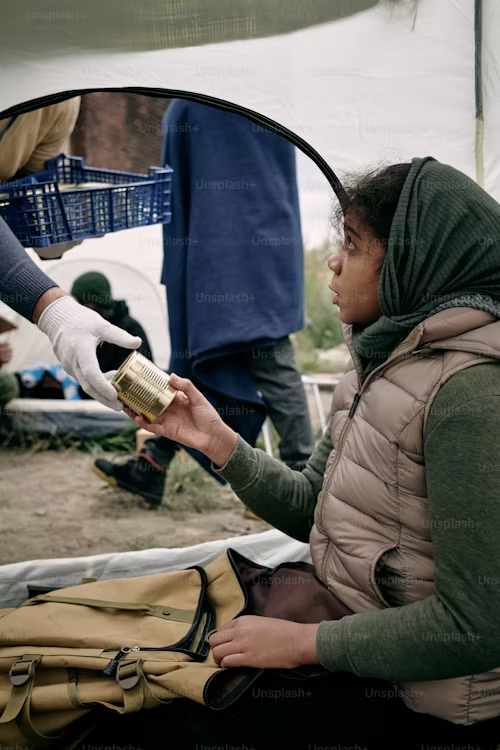
I’m proposing that two approaches may be useful in engaging with poverty issues:
- an intersectional approach: as Mahadevan and her colleagues explain we need to consider ‘the interrelated facets of culture, power and diversity’. Poverty affects different people in different ways, according to power relations in society. Culture is a factor, but poverty is not ‘cultural’ as Mead suggests (above). This is a narrative created through power relations, and partly reflected in business strategies that suggest endogenous approaches to poverty alleviation can be overridden.
- a narrative-counternarrative approach: dominant narratives in international business and management, such as bottom-of-the-pyramid that claim to address poverty on an international level, should be scrutinised and challenged where counter-narratives can be constructed that encompass intersectional approaches. Power relations are an obvious factor that is often neglected in cross-cultural management studies. Endogenous arrangements for protecting against financial shocks, encouraging enterprise and addressing poverty-related issues within local communities in Africa and other regions, such as rotating savings and credit associations (ROSCAs), are often driven by women who can be the hardest hit by poverty They are often the ones most affected by the manifestations of BoP strategies such as mobile money, driven by global power dynamics. Such institutions as ROSCAs are part of the socio-cultural fabric of life in local communities that are over-ridden by such ‘global’ interventions. It is our job to critically scrutinise such narratives from a cross-cultural perspective.
Poverty and inequality are such huge factors in both domestic and global society that they cannot be ignored by cross-cultural management scholars. We have the insights and expertise to contribute to its understanding, the way it affects societies and corporations and its part in wider societal life, as well as the international role of corporations in contributing to or alleviating poverty.
An earlier version of this post was published as an Editorial in International Journal of Cross Cultural Management.
Featured image: Aloys Wach (1892-1940) Austrian expressionist painter ©Public domain (https://picryl.com/media/wach-poverty-aabc5d)
© Terence Jackson 2024

