
Migration, whether irregular or regular, is a fact of life. Nothing strange or unusual. Many of us are likely to be the product of migration if we take a long enough time view. Yet it is one of the most politicised aspects of our lives. Don’t just think Brexit. Don’t just think attacks (political and physical) on asylum seekers in recent years. Don’t just think the rise of right-wing parties like the National Front. Mobilising resentment towards immigrants has a long history. In fact, I would assume, as long as migration has existed. Incomers into areas may put pressure on resources for locals, but have brought resources and prosperity to areas deficient in labour, finance, services and products. Mostly, in the field of management studies, we are concerned with the way it has altered dynamics in organisations, and in cross-cultural management studies, the way it has affected cross-cultural dynamics in organisations. This is, as always, putting the focus on the effectiveness of mainly commercial organisations. I guess this is our job. But what happens when we put the focus on the incomer: the migrant; the refugee; the asylum seeker – the person who has been through the experience, not the organisation that has the advantages or disadvantages of employing migrants, or indeed being established by migrants.
There are a lot of terms for migrants, some seemingly inoffensive or even positive, others pejorative: expatriate, diaspora, immigrant, migrant, irregular migrant, illegal migrant, refugee, asylum seeker. And some terms that members of the UK government have used: a ‘swarm’, ‘waves of illegal migrants breaching our border’, with the current UK Home Secretary adding that with 100 million people having the right to seek asylum in the UK: ‘let’s be clear – they are coming here’
But let us start from the experience of the migrant. Why they left their homeland. Their journey. Their arrival. Their integration. The relevance of migration to cross-cultural management studies, and what we as scholars have to offer, is captured in these stories.
Motivation
Let’s start at the beginning with motivation. What motivates an individual or family to leave their home, pay traffickers to smuggle them out of their country and into another, and to make a perilous journey across an uncertain and dangerous sea (Mediterranean, Channel), to an uncertain but often hostile reception in a potential host country? A major motivation appears to be desperation. In February 2023, 59 people, including children and a baby, died crossing the Mediterranean Sea from Turkey to Calabria, Southern Italy. Out of an estimated 140 to 150 passengers only 81 people appear to have survived after the inadequate craft smashed into rocks trying to land on the tourist beach of Staccato di Cutro. Certainly the people on board from Afghanistan, Pakistan and Iran, were not on a pleasure cruise. In June of this year, the above worse ever tragedy of this sort has been supplanted by the news that as many as 500 people were missing presumed dead from an old fishing vessel used to smuggle them from Libya to Greece, and described as a ‘floating coffin’. It is unlikely the people on board either vessel were trying to migrate to a European country to further their careers, although they may have thought of better job opportunities. Perhaps, as is often mooted, they thought they could sponge off the welfare state in an EU country, to have an easy life, or to take the job of a local by undercutting local wages! This seems unlikely. It is more likely they were fleeing, not from a job they did not like in their home country, not because they didn’t like the boss, but because they were under threat to life in a war zone, from political or religious persecution, or had lost their livelihood through the effects of climate change: flooding, draught, desertification, crop failure. A recent article in the UK’s The Mirror reports on Farzad, who escaped from Iran fearing for his life due to religious persecution. He arrived in the UK in 2019 after a dangerous Channel crossing in a small boat. He says
I haven’t heard from anyone who hasn’t been traumatised by that experience. On that boat I remember people being so afraid. Some people were crying, one went into a temporary coma, they were shouting for their children or their parents. It was a horrible experience. No one who makes that journey would do it for fun.
Although many of his fellow refugees fleeing via Turkey were headed to Germany or France, he wanted to travel to the UK because he spoke English. Yet to apply for asylum he had to enter the UK (illegally). If there was a mechanism for applying from abroad he would have done so. Ultimately he obtained refugee status, yet with an estimated 45,000 people crossing the Channel in this way last year, and 82% of Iranian asylum seekers’ applications being approved, the UK government are disqualifying all asylum seekers crossing the channel in small boats from making an asylum claim, without appearing to offer any safe route to making a claim, and the prospect of detaining thousands for an indeterminant period of time, and eventually sending them ‘home’ or to a third (‘safe’) country (Rwanda!).
It is within this context that migrants seeking asylum arrive in countries hoping for some form of sanctuary, having suffered trauma, often impoverished, and having a very weak voice in the encounters to come, and a lack of agency in the policies and laws they are subject to. In terms of considering subsequent cross-cultural interactions (which are likely to be with people in authority – immigration officials, police, social workers and welfare officers, NGO workers, employers, landlords) the stark reality of unequal power relations in cross-cultural encounters is palpable, and is very much subject to the type of leadership qualities displayed by the people in policy-making roles who influence their lives and outcomes and by the people they meet.
Leadership
Political leadership on the issue of migration in European countries and beyond is often antagonistic and adds to the problems that migrants face if they survive a perilous journey (many don’t: for example, an estimated 25,983 have died or gone missing in the Mediterranean since 2014 according to the International Organisation for Migration), and often during that journey. The prime minister of Italy, Giorgia Meloni, whose government came to power in October 2022, has imposed punitive sanctions on sea rescue charities in an attempt to curtailed their efforts to rescue migrant boats in distress. Most governments, such as Italy’s, argue that such policies to tackle illegal immigration are directed towards the traffickers, to disrupt their business. Although it seems to me the more this is driven underground and the more governments attempt to disrupt such crossings, the more traffickers will ply their trade. Creating legal and regulated routes would seem to suggest a way forward.
Yet sometimes governments slip up, and put the blame directly on the migrant, with the emphasis on stopping a ‘swarm’ of migrants (in the words of former UK prime minister David Cameron) and creating a ‘hostile environment’ for illegal immigrants (ex UK prime minister Teresa May), and forcibly transporting illegal immigrants from the UK to Rwanda (ex UK Home Secretary Piti Patel). The idea of the latter is that migrants will be discouraged from making the journey and therefore the demand for the traffickers service will decline, putting them out of business. It’s main effect is likely to be the further demonisation of migrants (as a ‘swarm’ that nobody wants, and they are probably criminals anyway so let’s transport them to Rwanda – with echoes of Botany Bay, Australia as a destination for convicted criminals).
Valuing diversity, resilience and commitment to learn
It is understandable that this degree of hostility from our ‘leaders’ engenders an atmosphere not just of ‘othering’ of ‘illegal’ migrants, asylum-seekers, not just a lack of understanding or of empathy of such migrants, of their motivations for migrating and the difficulties that they face in their host countries, not just a mistrusts, but an open hostility towards migrants.

This may be connected to racism, but not exclusively so, as Britain appears to have a policy of returning Albanian asylum seekers to Albania. Criminal gangs are thought to be a problem (although it should be noted that although a European country, 59% of the Albanian population recorded their religion as Islam, compared with 17% Christian). Irregular migrants are prime targets for racism and xenophobia. The concept of such migrants as ‘illegal’ adds to the association of irregular migrants with criminality such as trafficking and drugs, and fuels xenophobic hostility (ILO). The UK governments Illegal Immigrants Bill, making all immigrants coming into the UK by irregular means criminals does not help this situation. The fact that those fleeing from their home countries are often well qualified professionals, and tradespeople, and in sometimes shortage professions in host countries such as the UK, appears to make little difference. There have been recent reports, for example, that trained medics (reportedly thousands of doctors, nurses and other medical professional) are stuck in asylum limbo, despite labour shortages in the NHS of some 154,000 full time staff. Simply from a management perspective, there must be another way of looking at this.
I finish on a more positive note, and look at the approach of Ernst and Young (EY), through their Diversity Charter refugee support team in Germany:
That the refugees on EY’s apprenticeship scheme had managed to flee horrific warzones and cross vast distances in difficult conditions to make it to Germany, meant they had already overcome far greater obstacles than anyone would encounter in the workplace.
Irregular migration is not for the faint hearted. It is normally undertaken not simply out of necessity, but also by the most enterprising individuals within a community (which may or may not be fuelled by desperation). Ernst and Young view this as a positive, contributing to diversity within the organisation, often leading to more creative decision-making, problem-solving and innovation.
This may seem far from the approach that appears to be taken by the British and other governments. There is a pool of talent within the ranks of refugees, yet they are often stuck in a process, frequently incarcerated (including in offshore barges reminiscent of convict barges from the 19th century) and sometimes threatened with deportation to countries to which they have no connection, and may also be unsafe.
Ernst and Young provide a useful case study where the diversity and personal qualities of refugees are seen as a positive in organisations and in modern societies generally. This, coupled with an empathy towards the irregular migrant, in the Ernst and Young case understanding the issues facing refugees. For example, one apprentice within their refugee programme was consistently late for work. It turned out he was homeless, unwilling to live in a refugee shelter. He was sofa-surfing among his friends. He was struggling to judge his commute time from the different locations he stayed at around the city. A problem to be solved through empathy and understanding.
It is unfortunate that as cross-cultural management scholars, we have such an insignificant voice in the corridors of power. We speak about leadership, yet fail to gain access to the real leaders of our countries, whether in government, the media or in the transnationals that may have some power in shifting policy, strategy and opinion. There are well informed colleagues working in this area. Much of their work attests to the contributions that migrants make to organisations, but also the types of issues they face. For this, I would refer you to the Special Collection on Immigration on the webpages of International Journal of Cross Cultural Management. Yet most of this work concerns regular, rather than irregular, migrants. Many of the issues described in this collection are amplified for irregular migrants, but also there are unique problems that have to be overcome by individuals, families and organisations, that cross-cultural management scholars should be interested in, including: the issue of the racial nature of migration; the gendered nature of migration, and; the lack of voice of migrants in a cross-cultural dialogue that barely exists. What irregular migrants can offer organisations and enterprises is not part of the dialogue. The narrative created by our leaders around the ’swarm’ of illegals, is one of inconvenience at best and of blame (criminality, taking our jobs, sponging on the state) at worse.
Cross-cultural management scholars should contribute to a counter-narrative; should help in providing a voice for irregular migrants in what they can contribute to creative and empathetic organisations.
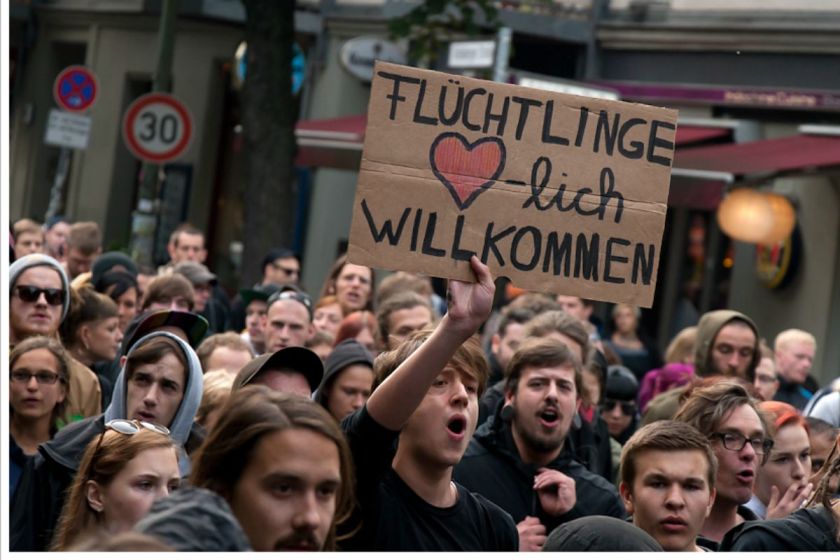
(Featured image: Refugees from Syria being welcomed in Germany)
© Terence Jackson 2023
 Terence Jackson